

Spread betting is a way to bet on price changes without owning the asset. You decide if a market will go up or down. Your profit or loss depends on the market’s move from the start point.
You only need to deposit a small amount of the total value, which is called leverage. This can increase both gains and losses. It’s possible to lose more than you put in. Spread betting companies make money from the spread difference, not commissions.
Spread betting is like betting on sports scores but for financial markets. A spread sets the expected movement range. Just as bookies use minus for favorites and plus for underdogs, spread betting has bid and ask prices to balance bets.
This guide will teach the basics of spread betting, including how to calculate and read spreads. You’ll get tips for different sports and markets. It covers important risk management tools like stop-loss orders. However, it’s not open to U.S. residents because of legal reasons.
The term “Spread Betting Explained” will come up to help you grasp key points. This background aims to set you up for more complex topics like strategies and examples.

Spread betting lets you guess if a market will go up or down without owning the asset. You choose how much to bet per point. The bid and ask are set by your provider. Then, your profit or loss is the price change times your bet. Trades often use leverage, meaning you only need a margin, not the full value. Remember, spread betting’s legality varies, and it’s often not available in the U.S.
If you decide to buy or sell at a quoted spread, you set your bet per point. Let’s say you sell at a price and bet $20 per point. Your profit or loss is the difference between the entry and exit prices times $20. With leverage, a $50,000 position might need just a 10% margin or $5,000. For a $10,000 position with a 20% margin, you’d need $2,000. Stop-loss orders can close your position at the best market price once triggered.
Guaranteed stop-loss orders ensure closing at your set level, but they cost more. In volatile markets, spreads can widen, margin calls increase, and prices change quickly. You can lower risk with hedging or using guaranteed stops and smaller bets.
In spread betting, you don’t own shares or contracts. It’s based on price movements. Traditional betting pays fixed odds on a win or loss. Spread bets may have no commission and can offer tax benefits in places where gains are seen as gambling winnings.
Unlike CFDs and stocks, some spread bets have fixed expiries. Shorting is easier with spread betting as you don’t need to borrow shares. Be mindful of margin calls and how closing positions works differently from actual stock trading.
Traders and bettors enjoy taking long and short positions without needing to borrow. Leverage lets you handle bigger amounts with less money, attracting those with limited funds. The method is similar to sports betting, making it feel familiar to many.
Platforms like IG and CMC Markets make it easy to start. But leverage can increase both wins and losses. Spread betting isn’t available everywhere due to regulations. Always check your local laws first.
To trade or bet well, you must understand the spread. This part explains how it works, shows examples, and offers tips for better wagers or trades.
Bookmakers give a bid/ask price based on the market price. The spread in betting includes the provider’s margin, meaning no extra fees. For instance, if a stock has a bid/ask of $200 / $203, and you sell at $200 and close at $188, you make $240. But if it closes at $215, you lose $300. This shows the impact of your initial price and the margin.
Covering the spread means the market moves in your favor beyond the quoted level. In sports, covering happens when a team’s win margin is larger than the point spread. If a margin matches the spread, it’s a push, and bettors get their money back. In finance, a push can also mean a price change that only covers costs, leaving you with no profit. This helps in planning and setting targets.
Market changes, like volatility or big news, can widen or tighten spreads. For sportsbooks, they adjust lines to balance bets and minimize their risk. Wider spreads mean higher costs for you, possibly triggering unintended losses. It’s wise to expect spread changes during key events and plan your bets accordingly.
Bookmakers use the spread to balance bets and ensure a profit without charging fees. It helps them manage risk. For example, sportsbooks adjust spreads to encourage bets on both sides. This approach keeps them able to operate while providing clear costs for bets or trades.
For sound betting advice: always compare the bid/ask levels, pick your provider wisely, avoid betting before significant events, and account for the spread when sizing your positions.
| Topic | What to Watch | Impact on Your Trade or Bet |
| Quoted bid/ask | Size of spread around mid-price | Directly affects entry cost and profit/loss |
| Market volatility | News, earnings, injury reports | Wider spreads; higher trading costs |
| Liquidity | Number of participants and volume | Tighter spreads when liquidity is high |
| Bookmaker actions | Line moves, juice adjustments | Changes incentives and balances liability |
| Push scenarios | Exact match to quoted level | Result can be no net gain after fees |
To understand a spread bet, look at the market’s quote and your position. These bets involve a bid (sell price) and an ask (buy price). If you think the price will go up, you buy at the ask. Sell at the bid if you predict a drop. The profit or loss is the difference between closing and opening prices, multiplied by your stake. This simple calculation applies to stocks like Apple or indices like the S&P 500.
Let’s break down the essentials you need to grasp: quotes, margin, and costs. This way, you can make informed decisions before entering a trade.
The spread is the gap between the bid and the ask prices. In sports betting, it indicates the needed win margin. For financial markets, it reflects liquidity and set prices. Consider this: if ABC stock is 100/102 and you buy at 102 for a $10 stake, your total is $1,020. With a 20% margin requirement, you’d need to deposit $204.
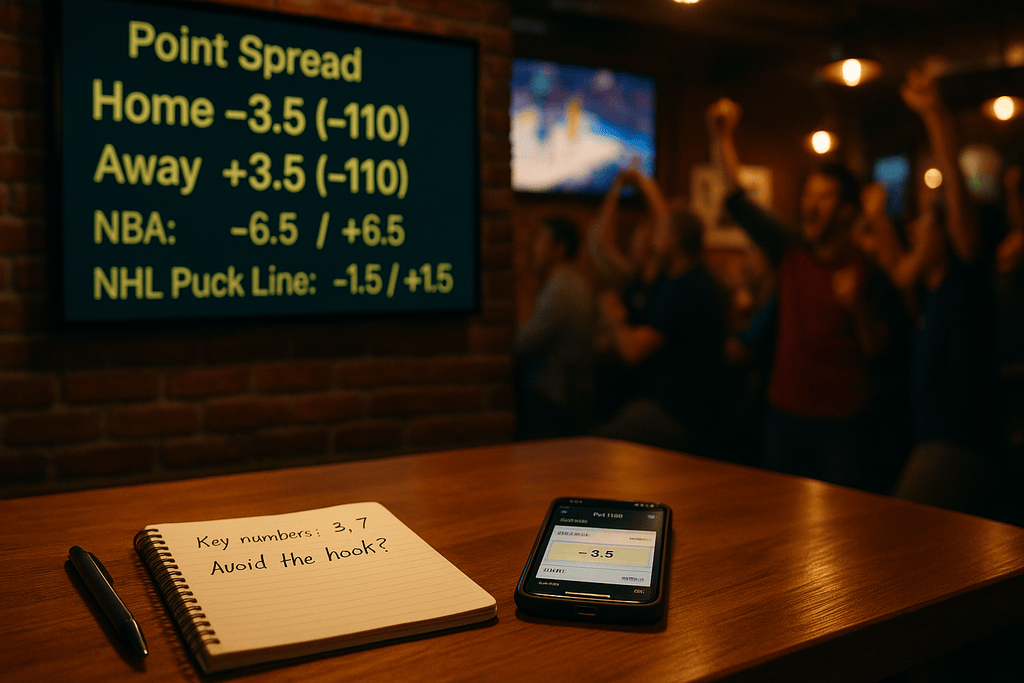
In sports betting, favorites get a minus, underdogs a plus. If a team is at -3, it needs to win by over three points. The +3 underdog can afford a narrow loss or win. Understanding these signs helps you navigate spread bets and pick sides correctly.
The hook adds a half-point to prevent ties. For example, a 3.5 spread avoids a 3-point deadlock since half points don’t exist in sports. Financial markets use similar tactics to eliminate draws. Knowing about the hook can help you plan better and skip tie scenarios.
Juice, or vigorish, is the bookmaker’s fee. A typical sports bet might be -110, where $110 bets $100. Spread betting often hides this fee in the spread, affecting returns. Changing the juice, like from -110 to -120, alters costs. If you adjust the spread, it may improve your position but also increase costs and lower returns.
Higher spreads and juice mean more trading expenses. It’s smart to review a provider’s execution quality and margin requirements before trading. Brands like IG, CMC Markets, or Betfair offer benchmarks. This approach helps manage risks and clarifies how spreads influence your actual results.

Spread betting concepts stay the same across sports, but the rules can change. You can learn how spread betting works in football, basketball, baseball, and hockey from Spread Betting Explained. It talks about favorites, underdogs, and other terms. It also discusses how rules affect betting in each sport.
In NFL betting, spreads show the expected difference in scores. Important numbers include 3 and 7, thanks to field goals and touchdowns. If you bet on a team at -3, they must win by four points or more for you to win. A match ending with exactly a three-point difference is a push, meaning you get your bet back.
In the U.S., NFL spread betting is very popular. Bettors often choose straight bets on the spread. You’ll also find parlays, teasers, and live bets. Teasers let you adjust the spread to your advantage but reduce your payout.
NBA spreads predict the final point difference, considering the high scores in basketball. It’s smart to look at the game’s pace, injuries, and player rest. Unlike football, basketball doesn’t have key numbers because scores change a lot.
NBA betting includes live betting and bets on player or team performance. These bets can be on different game parts or specific players. Spreads change quickly based on new information about the game.
Baseball betting tends to use moneylines or run lines, not point spreads. The usual run line is +/-1.5 runs, similar to a spread. With baseball’s lower scoring, pushes on run lines are less common than with point spreads.
You can also bet on over/under totals or player actions like hits or strikeouts. It’s a good idea to compare different sportsbooks when betting on run lines or moneylines.
The NHL uses puck lines, often at -1.5/+1.5, to accommodate low-scoring games. Slower scoring and overtime can change how these lines are set. Live betting is quite popular in hockey because the game’s momentum can shift quickly.
Prop bets and specific team bets are common in NHL because goals are rare but meaningful. Understanding goaltender performance and special teams can give bettors an edge.
Whether it’s NFL, NBA, MLB, or NHL betting, it’s crucial to manage your bankroll and understand key numbers and hooks. Always look for the best lines, no matter if you’re betting on spreads, run lines, or puck lines.
To get better at spread betting, use specific strategies. Have a clear plan. This should cut risks and keep track of your bets. It should focus on just one sport or market. Being disciplined helps when things suddenly change.
In football, numbers like 3 and 7 are crucial because scores often end with these margins. You might want to adjust your bets to benefit from this trend.
Study the trends of key numbers by conference and each season. Focusing on the NFL, for instance, helps find where the betting lines may be off. Use past game results to decide on your betting strategy.
Look around at different sportsbooks to find the best betting lines. Doing this helps you pay less and win more in the long run.
Sportsbooks change their betting lines based on where people are putting their money. Always check multiple places before you decide where to bet. This ensures you get the best deal.
Middling is betting on both sides to try and win both bets. For example, bet on the favorite team at -3 at one place, and the underdog at +3.5 at another. If the game ends with a 3-point difference, you win both bets.
In financial betting, hedging could mean taking opposite bets to minimize losses. Using contracts like CFDs can help secure profits. These strategies need careful planning and control over your money.
With alternate spreads, you pick a different line that alters the risk and potential payout. In sports, buying half-points can dodge betting traps, but it costs more. In finance, you might choose a bigger spread for a different risk/reward.
Managing your risks is key with alternate spreads. Always set limits on your losses, and don’t risk too much on one bet. Be careful of risky periods that could affect your bets.
Keeping good records helps with taxes and making better betting decisions. Setting loss limits and not betting too much are wise moves. These steps help you improve your betting strategy over time.
Spread Betting Explained breaks down important points to know before you start. You can bet on price changes without owning the actual asset. This means using leverage to increase potential wins or losses. Also, you often don’t pay commission because the providers make money from the spread. However, the tax rules are different in each country. In the UK, spread betting has tax benefits, but it’s not allowed for U.S. residents right now.
This summary talks about the big risks and how to handle them. It’s possible to lose more than you put in, so using stop-loss orders is smart. Also, think about choosing guaranteed stop-loss orders if they’re available. Prices can change quickly, especially during big news or company earnings reports. This can make spreads wider and costs higher.
Think of financial spreads like sports betting to understand them better. Imagine favorites and underdogs, and how small changes, called hooks, can change outcomes. Think about the “juice” or cost affecting what you win, and how certain numbers are more important in football or basketball betting. Using these sports ideas can help you understand market trends better. This strategy works for both sports and financial spread betting when it’s legal.
Here are steps to take before you begin. Learn how much money you need to start, check different providers like IG or CMC Markets, and try using a demo account first with small bets. It’s crucial to manage your risk well, like not risking more than 2% of your funds on one bet. Talk to a tax advisor to understand the risks and benefits of spread betting. Make sure to also check the rules in your area before you start trading.
| Aspect | What to Watch | Practical Tip |
| Leverage | Magnifies gains and losses; margin calls possible | Use smaller position sizes and set stop-losses |
| Costs | No commission but spreads and overnight financing apply | Compare spreads across providers before opening positions |
| Volatility | Spreads widen and stops may trigger during news | Avoid trading around major economic releases or use guaranteed stops |
| Tax and Legal | Rules differ by country; unavailable in the United States | Consult a tax advisor and check local regulations |
| Strategy | Use key numbers, line shopping, and hedging methods | Practice with a demo and follow the 2% rule |
Spread betting is a way to bet on the price changes of financial instruments or event outcomes without actually owning the asset. You guess if a market will go up (buy) or down (sell). The difference between the buy and sell price, multiplied by your bet, determines profit or loss. It involves leverage, which can increase gains or losses. In some places, spread betting offers tax benefits, though it varies.
When you spread bet, you pick how much to bet per point change. The provider gives you a buy and sell price. If the market moves as you predict, you make money; if not, you lose. Let’s say a stock is quoted at 200/203, and you bet $20 per point it will fall. If it closes at 188, you’ve earned $240. But if it closes at 215, you lose $300. Leverage means you only need a small deposit, but risks are bigger.
In spread betting, you don’t actually own what you’re betting on. Costs are included in the spread, so no separate fees. With CFDs, there’s no fixed expiry and you might pay commissions. Spread betting could be tax-free in some places, unlike CFDs. Also, spread betting isn’t available in the U.S.
People like spread betting for several reasons. It lets you bet on markets going up or down without needing to own the asset. You can start with a small amount of money and still control big positions, thanks to leverage. The way costs are included in the spread makes it simple for many. However, leverage increases risk.
The spread is the difference between the buying and selling prices quoted by the provider. You buy if you think the price will rise and sell if you believe it will fall. This spread is how providers make money. A wider spread means a higher cost for you and can impact your profits.
Providers decide on the spread using current market prices, expected volatility, and other factors. For instance, a 3-point spread on a quote means your profit or loss is calculated from your entry point, multiplied by your stake per point. In volatile markets, providers may increase the spread to manage their risk.